
Perfume discovery set packaging should be developed around the finished sample vial, including its closure and label. Confirm that specification first, then use actual samples to develop the insert, removal openings, and box clearance. Approve the filled set with its scent guide and shipping pack so the production order captures how every component fits.
A discovery set needs to hold each vial securely while letting customers remove it, identify the fragrance, and return it to its position. The following checks give the vial supplier, box supplier, and packing team a shared specification.

Start Perfume Discovery Set Packaging with the Finished Vial
Confirm Vial Count, Format, and Fill Volume
List the fragrances and the sample format for each slot. A plugged glass vial and a spray sample can have different overall heights, closure shapes, and ways of opening. MUB lists plugged sample glass vials in 0.5, 1, 2, and 3 mL capacities. Obtain the selected model’s dimensions and matched closure before asking the box supplier to develop an insert. MUB sample glass vials
Measure the Capped and Labeled Sample
Give the packaging supplier finished samples and the relevant drawings. Include the label seam and any area where a wrap label increases the diameter. Use the table below to record the information needed for perfume discovery set packaging.
| Artikel | What to record | Where it affects fit |
| Vial body | Outside diameter, shape, and dimensional tolerances | Insert opening and body support |
| Schließung | Maximum outside profile and fully closed height | Removal access and lid clearance |
| Label | Thickness, seam position, and artwork orientation | Grip, rubbing, and fragrance visibility |
| Filled vial | Intended fill volume and assembled weight | Support during handling |
| Set contents | Vial count, cards, blotters, and accessories | Internal layout and closed box depth |
Two vials with the same nominal capacity can require different openings. Review the finished samples against the drawing before the supplier fixes the insert tooling.
Design the Insert Around Retention and Removal
Support the Vial Body and Control Movement
Ask the insert designer to identify where the structure holds the vial. Check those contact points on the sample, including whether the vial can rotate, slide along its slot, or touch neighboring glass. For a horizontal layout, inspect support along the body and movement at both ends.
Evaluate fit with the intended insert material. A paperboard tab and a compressible foam opening hold a vial differently, so each design needs its own sample check.
Leave Room to Grip and Return Each Sample
Provide access to the vial body through a finger opening, exposed section, or another feature suited to the layout. Have someone unfamiliar with the pack remove and return every sample. Watch whether they pull on the cap because the body is difficult to grip, or need to bend the tray to get a vial out.
Keep the Lid Clear of Caps and Actuators
Close the box with all vials, cards, and accessories in place. Check whether the lid or scent guide bears against a cap or spray actuator. Repeat the check with the tallest approved assembly and with components near the limits of their specified dimensions.
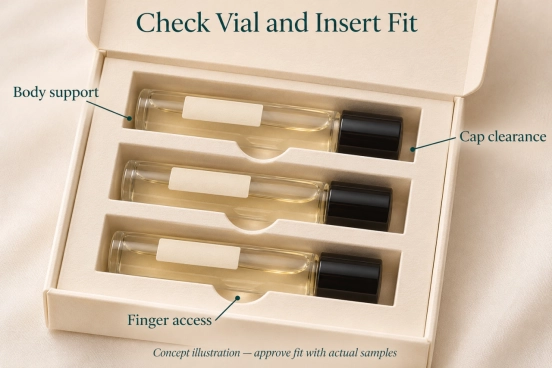
Choose an Insert Material for the Actual Layout
Compare materials using the same finished vials and proposed arrangement. Ask the supplier to explain how each option holds the samples and which material characteristics affect its fit.
| Insert option | Features to review | Sample questions |
| Folded paperboard | Cut openings, folded supports, tabs, and locks | Do the folds stay seated during packing and repeated removal? |
| Molded pulp | Formed pockets, support depth, and surface contact | Does each pocket hold the vial while leaving access for removal? |
| Foam | Opening profile, material grade, thickness, and compression | Can customers remove the vial easily, and does repeated use change its grip? |
Avantade’s Standard Coffret illustrates how a supplier defines a discovery-set range around particular sample formats. Its listing specifies configurations for three to ten units and identifies the supported vial capacities. Request confirmation for your exact vial even when a catalog lists the capacity you need. Avantade Standard Coffret
If you change from glass to plastic during sampling, send the revised container to the insert supplier. Recheck its dimensions, weight, and behavior during insertion and removal. MUB glass and plastic sample bottle guide
Arrange the Vials, Labels, and Scent Guide Together
Keep Fragrance Names Visible After Removal
Place a readable fragrance name or code on each vial. Customers may take several samples out at once, so check identification with the vial outside its slot as well as inside the box. For a horizontal tray, confirm that the label faces the reader when packed.
Match the Packing Order to the Printed Guide
Use a packing diagram that links each slot to a fragrance and its guide entry. Pack a trial set from that diagram, then compare the vial labels, slot markings, and booklet. Keep the diagram available to the packing team when artwork or assortment changes.
Test Every Approved Vial Count and Assortment
One outer box may serve several assortments if each version has an appropriate internal layout. For example, a six-scent and an eight-scent set might share an outer format while using different inserts. Approve each configuration with its actual contents and record how any unused space is controlled.
Approve a Complete Filled Sample Before Production
Check Fit and Repeated Removal
Use perfume discovery set packaging samples made with the proposed production materials. Insert, remove, and return each filled vial. Check movement with the box open and closed, and inspect the tray after repeated use for bent tabs, torn edges, or changes in grip.
Inspect Closure Integrity and Label Wear
Examine the closures after packing and removal. Look for displacement, wetness, or residue, and inspect labels where they contact the insert. Record any scuffing that affects the fragrance name or other printed information. If a vial leaks, investigate its closure and filling assembly as well as the forces applied by the tray.
Review the Shipping Pack and Record Revisions
Assess the finished set inside the shipping packaging intended for its distribution route. Agree with the responsible packaging and logistics teams on the handling tests and acceptance criteria. After testing, inspect the vials, closures, insert, printed guide, and outer box.
Record the approved vial and closure references, label version, insert drawing and material, box drawing, assortment, and packing diagram. When sourcing sample vials from MUB, include the selected model and request the dimensions and closure samples needed by your box supplier. MUB perfume packaging
Häufig gestellte Fragen
Can Different 2 mL Vials Share the Same Insert?
They may share an insert if their finished profiles and tolerances fit the approved design. Compare body diameter, closure shape, labeled dimensions, and overall height. Test every proposed vial in the same material and layout, including removal and return, before approving a substitution.
How Much Clearance Should a Vial Insert Have?
Set the clearance with the insert supplier using the actual vial, label, material, and manufacturing tolerances. The sample needs enough retention for handling and enough access for removal. Approve the opening dimensions and support features after checking the finished pack.
Can One Box Hold Several Discovery Set Sizes?
A shared outer box can accommodate several sets when each internal configuration is developed and approved for its contents. Confirm insert layout, empty-space control, scent identification, and the packing sequence for every version. Keep separate component and artwork references where the configurations differ.