
A logo can look crisp in an artwork file and lose clarity once it wraps around a small bottle. Foil, labels, and coatings bring their own limits around transfer, adhesion, and bottle curvature.
These are production decisions as much as design decisions. Before choosing a finish for custom essential oil bottles, define the bottle material, printable area, dispensing system, artwork, expected handling, and order plan. This guide compares four widely used options: screen printing, foil stamping, labels, and surface coatings.
Start With the Bottle, Formula, and Brand Requirements
The bottle sets the physical limits for every decoration method. Record its material, capacity, diameter, shoulder shape, color, and usable print area. A small roller bottle leaves little room for both branding and product information, while pronounced shoulders or changing diameters can limit graphic size.
Essential oil may reach the surface during filling or use, so test the finish for expected contact, rubbing, storage, and shipping. The supplier also needs the closure type because assembled components affect the visible area and handling.
Prepare these decisions first:
- Bottle material, color, and capacity
- Dispensing system and cap style
- Available decoration area
- Number of artwork colors
- Fine text, gradients, or photographic elements
- Number of product variants
- Expected quantity and reorder pattern
- Destination market and required label information
MUBTF’s 정유 병 include sample vials, roller bottles, refillable formats, amber glass, and matte black designs. Selecting the bottle model first gives the supplier a defined surface for evaluating the artwork.
Screen Printing for Custom Essential Oil Bottles
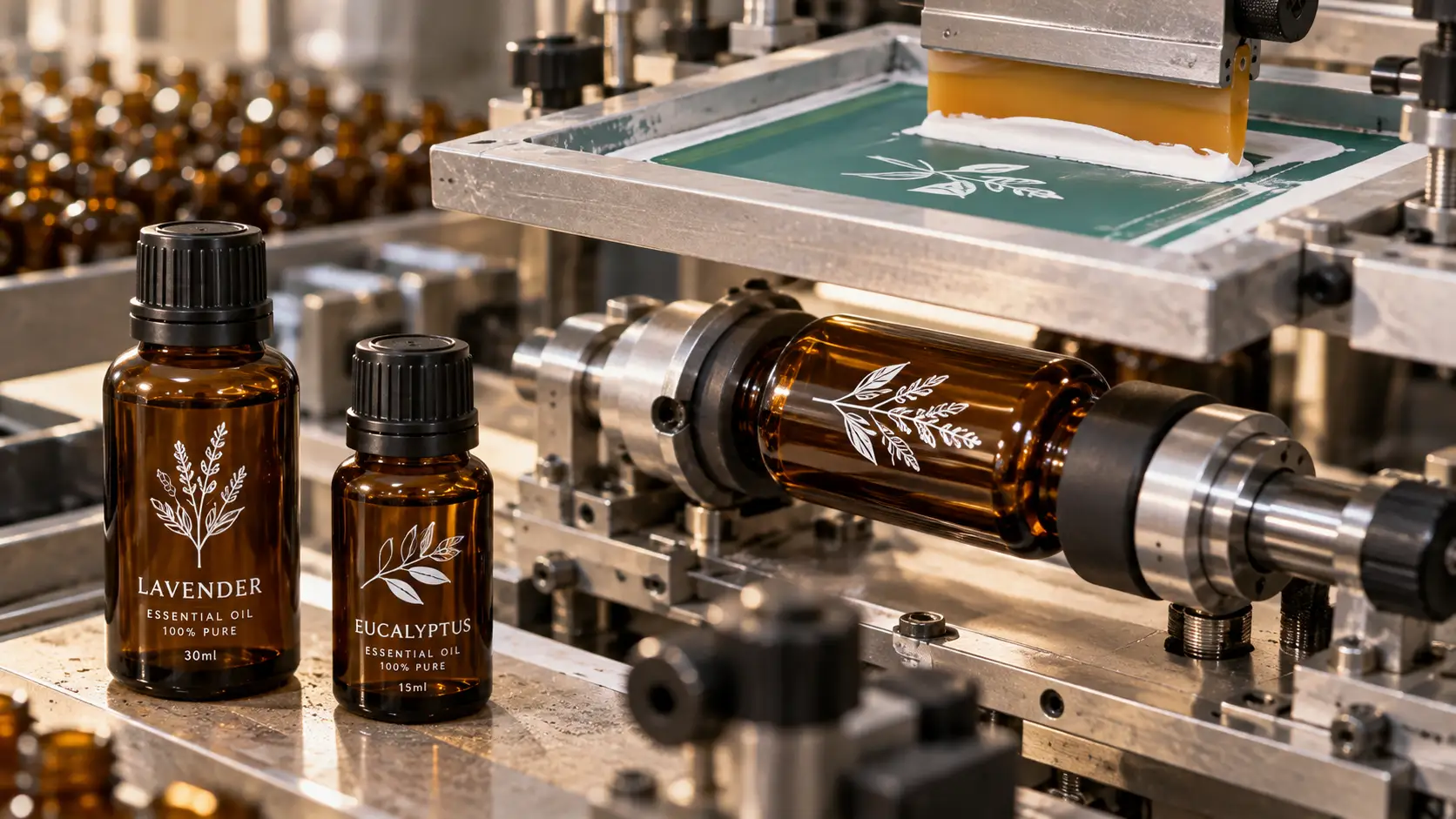
Screen printing places ink directly on the bottle and suits logos, product names, short text, and solid color blocks.
How Screen Printing Works
Ink passes through a prepared mesh screen onto the bottle surface. Separate colors require their own setup and alignment. Bold shapes and readable type work well; fine lines, small text, gradients, and photographs require closer review. Bottle curvature limits the width of an uninterrupted print.
When Screen Printing Fits the Project
Direct printing suits designs used across repeated orders with a manageable number of colors. Labels suit products with frequent artwork changes, many variants, or more text. Include setup cost, quantity, and color approval in the decision.
What to Check on the Sample
Inspect coverage, position, text clarity, and alignment. Rotate the bottle to review the curve, then perform the agreed rubbing check. Record approved dimensions and position with the physical sample.
Foil Stamping for Metallic Details
Foil stamping adds a metallic or colored accent by transferring foil to the surface with a heated die and pressure. Gold and silver are common choices, while the available foil range depends on the supplier and substrate.
This method works well for a logo, product name, border, or small decorative element and can be combined with a colored or frosted bottle.
On a narrow cylinder, the die has limited contact area and fine details may need adjustment. Large foil areas expose missing transfer more clearly. Foil over a coating also requires compatible materials and processing. Review line weight, foil area, placement, edge quality, and adhesion on the sample.
Use foil for focused metallic elements. Dense product information needs a method designed for legibility and revision.
Labels for Complex Artwork and Multiple SKUs
Labels carry detailed graphics and variable information efficiently. They are useful when one bottle serves several fragrances, when artwork includes gradients or multiple colors, or when the brand expects regular design updates.
Select Material and Adhesive for Oil Exposure
Essential oil packaging needs a label construction suited to the use environment. Synthetic materials such as BOPP and vinyl are commonly offered for applications that need resistance to oil and water. Matte or gloss lamination can add surface protection and change the visual finish.
Material names alone do not confirm performance. Test the proposed label on the production bottle with the intended product or an agreed test liquid. Check edge lifting, smudging, discoloration, and movement around the seam.
Fit the Label to a Small or Curved Bottle
Measure the physical bottle. A label extending into the shoulder or base may wrinkle, while a tight wrap may place the seam over important text. Apply a full-size paper prototype to check readability, barcode space, and overlap.
Hand and machine application may require different layouts, roll directions, or gaps. Confirm these details with the label producer and filling partner.
Coating and Frosting for Full-Surface Color
Coatings create a custom color, matte surface, gloss finish, or gradient. Frosting creates a translucent matte appearance.
Spray Coating
Spray coating covers the original bottle color and can receive screen printing, foil stamping, or a label when the processes are compatible.
Under consistent lighting, check the shoulder, base, neck, and recessed areas for color uniformity, texture, dust marks, and coating boundaries. Review caps and droppers beside the bottle.
Frosting
Frosting reduces transparency and gives glass a matte surface. Check even coverage and consistency between samples. Because the surface can affect later printing or labeling, approve the complete combination.
A decorative coating should not be treated as proof of formula protection. If an essential oil requires reduced light exposure, confirm the required bottle color and protection with the formula owner and packaging supplier.
Can These Decoration Methods Be Combined?
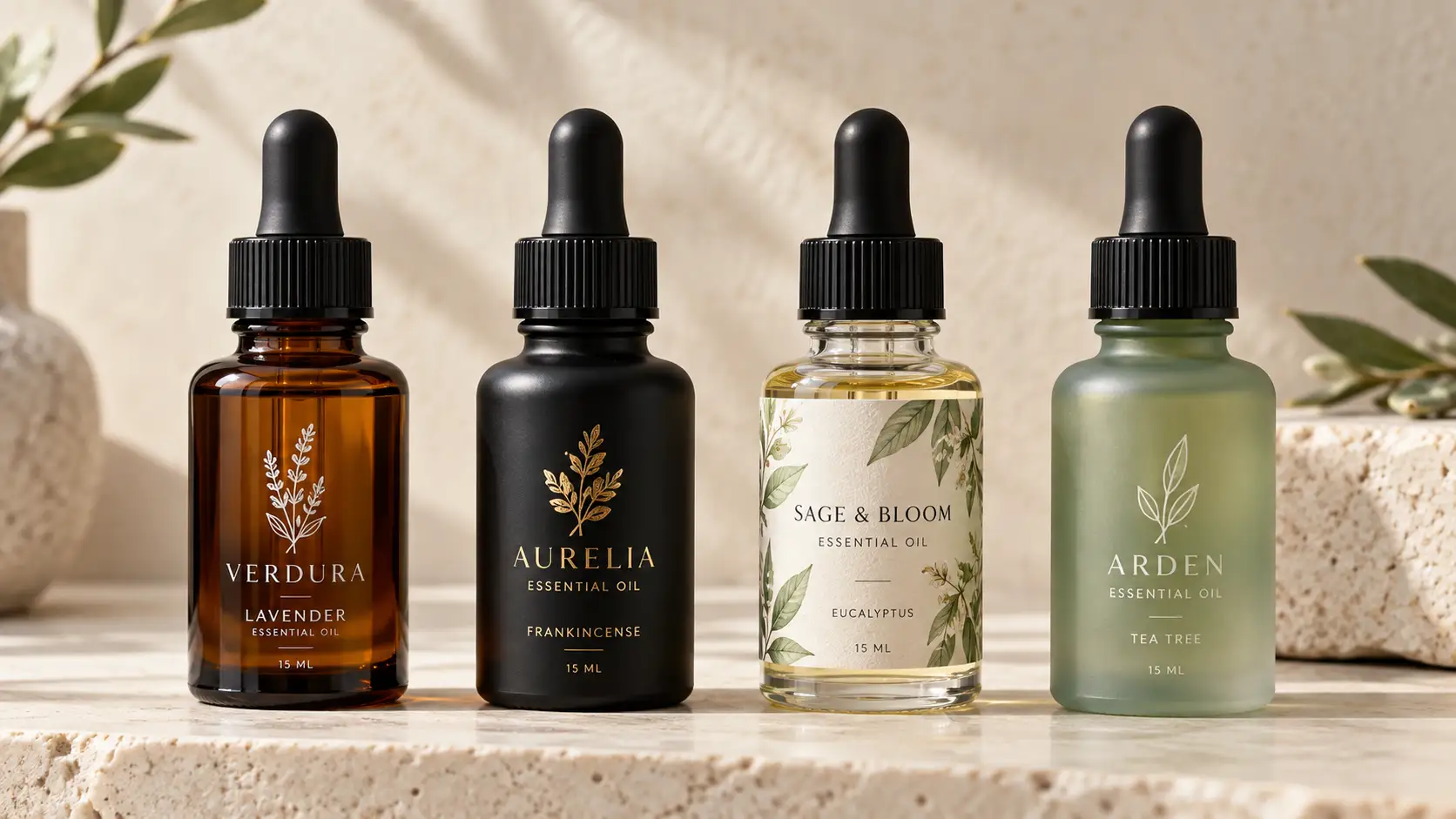
Combining methods lets each process handle a different part of the design. The production sequence and compatibility must be confirmed by the supplier because the bottle material, coating system, ink, foil, and curing requirements affect one another.
| Combination | Result | Main approval point |
| Coating and screen printing | Custom base color with direct graphics | Ink adhesion on the coating |
| Coating and foil stamping | Colored bottle with metallic details | Foil transfer and placement |
| Frosting and screen printing | Matte glass with a printed logo | Print clarity and adhesion |
| Label and foil details | Complex artwork with metallic emphasis | Label and foil durability |
| Screen printing and label | Fixed branding with variable SKU information | Layout and visual hierarchy |
Use the artwork proof and sample to establish a clear visual hierarchy among the selected finishes.
Prepare Artwork Before Requesting a Sample
A decoration quote becomes more useful when the supplier receives production-ready information. Send:
- The bottle model and capacity
- Vector artwork or the requested high-resolution format
- Exact print dimensions and position
- Pantone or another agreed color reference
- Number of print colors
- Requested coating, frosting, foil, or label finish
- Quantity for each SKU
- Closure and component colors
- Destination market and required schedule
Place the artwork on an available bottle drawing or decoration template, then confirm it on a physical sample. A digital mockup guides layout; it cannot reproduce the exact appearance of ink, coating, foil, or transparent glass.
MUBTF lists silk-screen printing, hot stamping, frosting, color coating, and polishing among its custom packaging services. The available combination, sample process, MOQ, and production schedule need to be confirmed for the selected bottle and artwork.
Inspect the Sample Before Bulk Production
The approved sample connects the design file to the production standard. Review it under suitable lighting and ordinary handling conditions.
Check:
- Color against the approved reference
- Logo dimensions and position
- Registration between printed colors
- Foil coverage and edge definition
- Coating or frosting consistency
- Label alignment, seam, and edge adhesion
- Readability of small text
- Response to agreed rubbing and oil-contact checks
- Color match between bottle and components
- Protection inside the outer packaging
Agree acceptable color and position tolerances with the supplier. Keep an approved sample and signed specifications for comparison with bulk production.
Brands using roll-on formats can also review MUBTF’s glass roller bottle range when matching the decoration to the bottle size and component structure.
Ordering Custom Essential Oil Bottles From MUBTF
MUBTF offers essential oil packaging that includes glass roll-on bottles, rubber dropper bottles, glass stick bottles, glass tube bottles, sample vials, and refillable formats. Its customization options cover the four areas discussed in this guide: direct printing, hot stamping, frosting, and color coating.
For a useful quotation, provide the bottle type, capacity, artwork, finish, number of colors, quantity by SKU, component requirements, and destination market. Use the project inquiry page to discuss whether the design fits a stock bottle or needs a more extensive custom process.
FAQ는
Q1: Is Screen Printing or Labeling Better for Small Essential Oil Bottles?
A: Screen printing suits concise, stable artwork such as a logo and product name. Labels support complex graphics, more text, and multiple SKUs. Choose after measuring the usable area and reviewing the number of variants and expected quantity.
Q2: Can Hot Foil Stamping Be Applied Over a Coated Bottle?
A: A supplier can assess this combination for the selected bottle and coating. Approve a sample that shows foil transfer, placement, edge quality, and adhesion on the finished surface.
Q3: What Label Material Works Around Essential Oils?
A: Oil-resistant synthetic materials such as BOPP and vinyl are common options. The material, adhesive, laminate, bottle surface, and formula exposure need to be tested together before production.
Q4: Can Different Decoration Methods Be Used on One Bottle?
A: Yes. Common combinations include coating with screen printing, frosting with screen printing, and coating with foil stamping. The supplier should confirm the processing order and compatibility of each layer.
Q5: What Should Be Approved Before Mass Production?
A: Approve the bottle, component colors, artwork dimensions, position, print colors, foil, coating or label finish, adhesion, outer packaging, and written production specifications. Keep the signed sample as a bulk-order reference.