
A bottle described as 50ml does not usually hold exactly 50ml when filled to the lip. The 50ml figure is its nominal capacity: the amount of fragrance the finished product is intended to contain. Brimful capacity is the greater volume the empty bottle can hold when liquid reaches the top of the opening.
The difference provides working space for filling, the pump, production variation and changing transport conditions. Before approving a bottle, confirm the nominal capacity, brimful capacity, target fill volume and assembled fill height.
The Short Answer
| Capacity term | What it means | How buyers use it |
| Nominal capacity | The stated commercial size, such as 30ml, 50ml or 100ml | Product range, label declaration and filling target |
| Brimful capacity | The maximum volume of the empty bottle when filled to the brim | Headspace calculations and bottle comparison |
| Target fill volume | The amount the filling line is set to dispense | Production control and net contents compliance |
| Headspace | The unfilled internal volume above the liquid | Room for the closure, handling and expansion |
The terms sound similar, but they answer different questions. Nominal capacity tells the market what size the product is. Brimful capacity tells the packaging team how much physical room exists inside the glass.
What Nominal Perfume Bottle Capacity Means
Nominal capacity is the size used to identify and sell the package. A fragrance range might include 30ml, 50ml and 100ml bottles. Those figures help customers compare products and help the brand plan prices, boxes and inventory.
The nominal number is not a promise that liquid will sit at a particular visible height. Bottle shape, wall thickness, shoulder geometry and base thickness all affect where 50ml appears inside the glass. A tall, narrow 50ml bottle may show a higher liquid line than a broad, flat 50ml bottle even though both contain the same measured amount.
Suppliers may use nominal, rated or standard capacity. Ask each supplier to define the term because catalogues are not always consistent.
Brands comparing shapes can start with MUB’s perfume bottle collection, then request the drawing and capacity data for each shortlisted model.
What Brimful Capacity Means
Brimful capacity, sometimes called overflow capacity, is the volume of liquid an empty bottle can hold up to the top edge of its opening. It represents the container’s physical maximum without the pump, stopper or cap in place.
A bottle needs a brimful capacity greater than its intended fill. If a nominal 50ml bottle also had a brimful capacity of only 50ml, there would be no room to insert the dip tube and pump without pushing liquid upward. Normal movement or temperature change could also force fragrance toward the seal.
Brimful capacity is useful for comparing bottles that share the same nominal size. A 50ml bottle with a 54ml overflow capacity and another with a 58ml overflow capacity both serve the same retail size, but they will show different headspace and liquid levels after filling.
The larger number is not automatically better. Too little space can complicate filling and sealing. Too much space may leave a visible air gap that customers read as underfilling. The right capacity relationship depends on the bottle design and finished packaging system.
How to Calculate Headspace
The basic calculation is simple:
Headspace volume = brimful capacity – target fill volume
Imagine a bottle with a 50ml nominal capacity, a verified brimful capacity of 55.5ml, and a target fill of 50ml.
| Item | Example value |
| Nominal capacity | 50ml |
| Brimful capacity | 55.5ml |
| Target fill volume | 50ml |
| Headspace volume | 5.5ml |
| Headspace as a share of brimful capacity | About 9.9 percent |
This example is illustrative, not an industry requirement. There is no single headspace percentage that suits every perfume bottle. The pump body, dip tube, neck shape, formula, filling process and shipping conditions all influence the final decision.
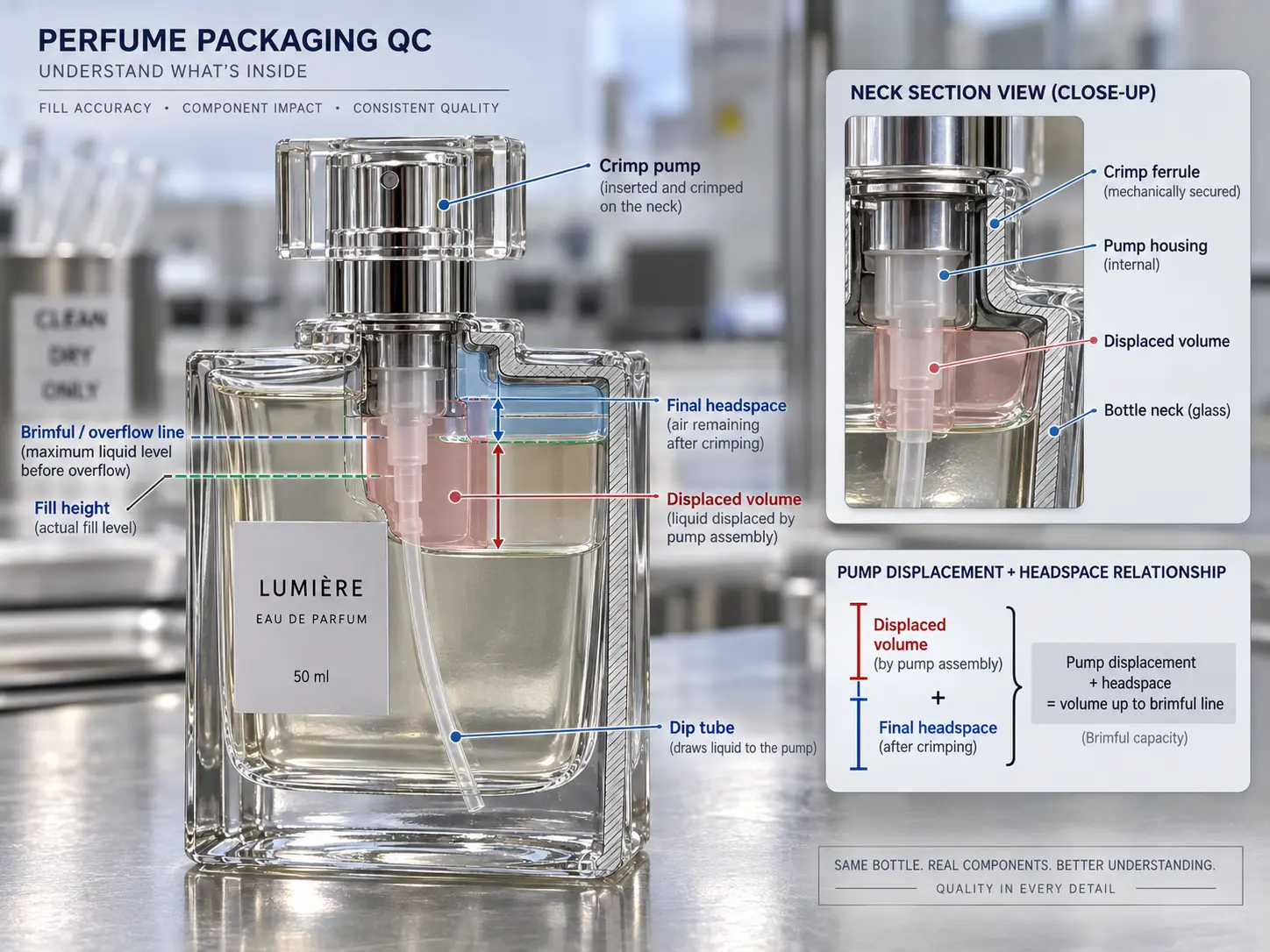
Buyers should also distinguish theoretical headspace from the visible space in an assembled bottle. The pump and dip tube displace liquid, so the level rises after the closure is installed. The apparent air gap may therefore be smaller than the simple subtraction suggests.
Why Perfume Bottles Need Space Above the Liquid
The Pump Displaces Liquid
The pump assembly occupies part of the bottle neck and upper cavity. Inserting it into an overfilled bottle can push fragrance onto the sealing surface or out through the opening. That creates cleanup work and may interfere with a clean crimp or screw seal.
Filling Lines Have Normal Variation
Filling equipment does not place every dose at an infinitely exact volume. The brand should set a controlled target and monitor the line so normal variation does not create underfilled units or bottles that are too full to close safely.
Liquid Volume Can Change with Temperature
Perfume may pass through warm warehouses, cold aircraft holds and changing delivery conditions. The formula and trapped air respond to temperature. Adequate space reduces the chance that liquid reaches the closure under expected storage and transport conditions, although headspace alone cannot correct a poor seal.
Customers Judge the Fill Line
Transparent glass makes the liquid level part of the presentation. A technically correct 50ml fill can still look wrong if the bottle has an unusually large upper cavity. Brands should approve the filled appearance, not only the empty bottle and its written capacity.
Why Two 50ml Bottles Can Look So Different
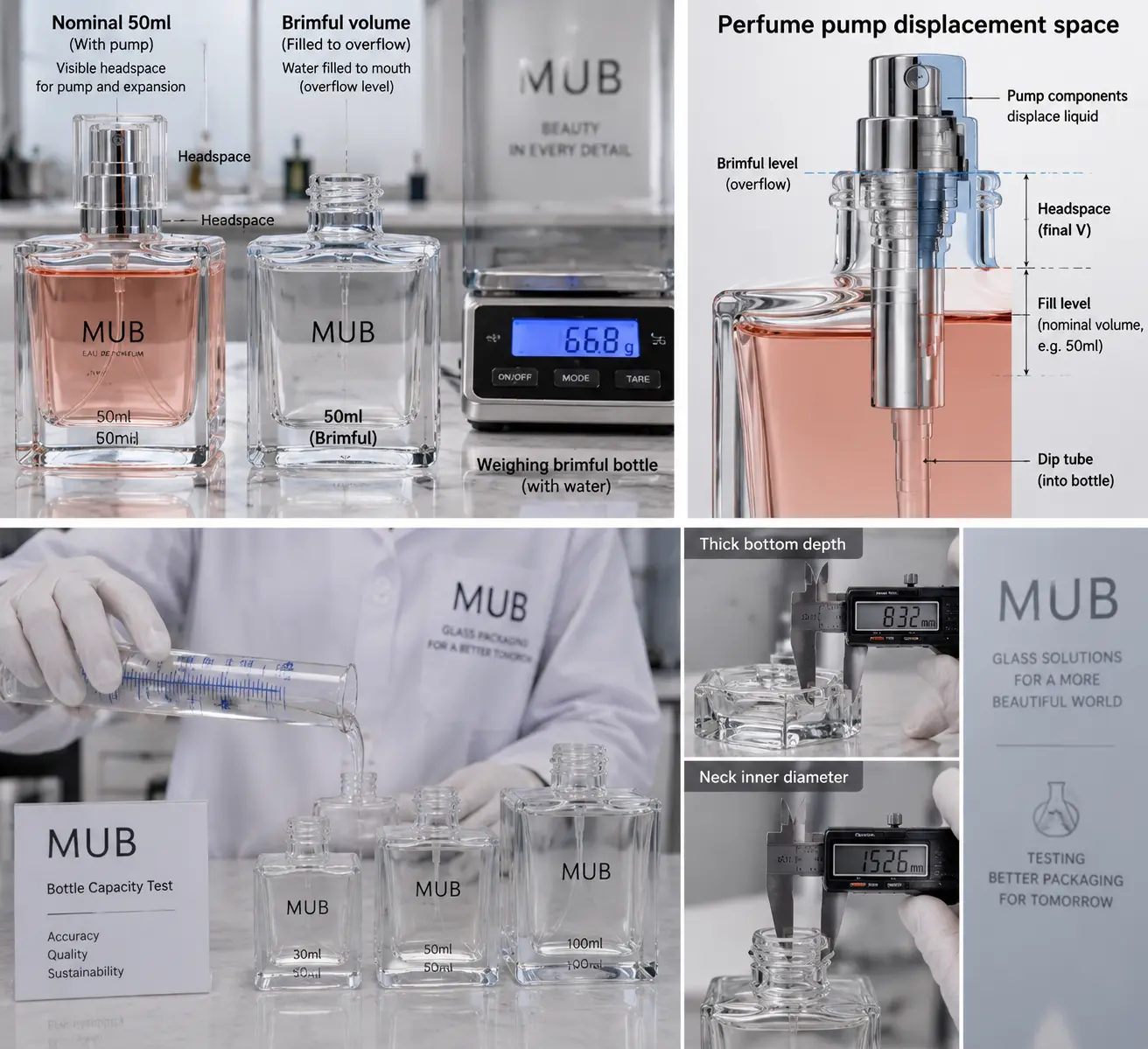
External dimensions do not reveal internal volume. Thick glass bases, deep push-ups, sculpted shoulders and heavy sidewalls reduce the space available for liquid. Manufacturers adjust the internal cavity so the bottle still reaches its intended nominal perfume bottle capacity.
This is easy to see in a bottle family. MUB’s 30ml, 50ml and 100ml square glass perfume bottle offers related sizes, but each size still needs its own confirmed drawing, fill trial and packaging dimensions.
Closure structure matters as well. A crimp neck and a screw neck can use different pump assemblies and neck geometries. Buyers working with a permanent retail closure can review crimp glass perfume bottle options before confirming the bottle, pump, collar and cap as one set.
How Manufacturers Check Brimful Capacity
A common method is to weigh the empty bottle, fill it with water to a defined brim point, and weigh it again. The mass difference is converted to volume using the water temperature and density. Whatever equipment is used, the reference point and method must remain consistent.
One bottle cannot describe an entire production lot. Glass manufacturing creates permitted variation in weight and internal cavity. The specification should state the target, measurement method and accepted tolerance, and identify whether a drawing shows a typical value or a controlled range.
The fragrance itself should not be treated as water for fill calculations. Alcohol, fragrance oils and temperature affect density. The filling partner should validate the actual formula, especially when the line controls filling by weight.
Capacity Details to Request Before Ordering
Ask the supplier for information that can be checked during sampling and repeated during production:
- Nominal capacity and brimful or overflow capacity
- Capacity tolerance and measurement method
- Bottle weight and weight tolerance
- Overall height, width, depth and base profile
- Neck finish and matching pump specification
- Intended fill height at the target volume
- Pump and dip-tube displacement
- Filled sample using the planned fragrance or a suitable test liquid
- Recommended carton orientation and transport tests
Keep the drawing, component codes and approved filled sample with the purchase specification. A product photo cannot establish perfume bottle capacity or confirm where the production fill line will sit.
Common Capacity Mistakes
- Treating nominal and brimful capacity as the same figure. Record both in the quotation and sample approval.
- Designing artwork around an empty bottle. Fill and assemble a sample before fixing a clear window, colour transition or label position.
- Raising the fill level for appearance alone. The target must still allow for closure displacement and tested performance.
- Comparing capacity from outside dimensions. Use measured values and drawings rather than estimating from height or width.
- Assuming nominal capacity determines carton size. A heavy base or tall cap can make a 50ml pack larger than some 100ml designs. MUB’s perfume bottle size guideconnects size with customer use, pricing and packaging.
A Practical Approval Process
Start with the retail size, shortlist shapes, and request drawings showing nominal and brimful capacity. Test several bottles rather than one perfect sample.
Fill them to the proposed target with the actual formula and install the production pump, collar and cap. Check the liquid line, seal and spray, then run the handling and temperature checks needed for the distribution route.
Finish with a small filling-line trial. Confirm the machine setting, closure application and reject criteria. Retain the approved sample and dated specification for bulk inspection.
Frequently Asked Questions
Is a 50ml perfume bottle exactly 50ml
It is sold as a 50ml nominal bottle, but its brimful capacity is normally greater than 50ml. The exact overflow capacity must come from the supplier’s drawing or measurement report.
Is brimful capacity the same as fill volume
No. Brimful capacity is the maximum volume of the empty bottle at the lip. Fill volume is the amount placed into the bottle during production.
How much headspace should a perfume bottle have
There is no universal percentage. Confirm enough space for the pump, filling variation and expected transport conditions, then approve the visible liquid level with a filled sample.
Why does the liquid level rise after the pump is installed
The pump body and dip tube occupy space inside the bottle and displace liquid. This is why the assembled sample matters more than an empty-bottle calculation alone.
Can brimful capacity vary between production batches
Glass weight and cavity dimensions can vary within the agreed manufacturing tolerance. The purchase specification should define how capacity is measured and what variation is acceptable.
Final Recommendation
Use nominal capacity to define the product size and brimful capacity to understand the bottle’s physical limit. Then validate the target fill, closure displacement and visible liquid line together.
Before approving a bulk perfume bottle order, ask for both capacity figures in writing, test several assembled samples with the real formula, and keep the final drawing and approved sample as production references. That process prevents avoidable filling, sealing and presentation problems.