
Put a bottle and a jar side by side and the quickest way to tell them apart is not their height or shape. It is the opening.
A bottle has a mouth that is noticeably narrower than its body, usually with a neck in between. A jar opens much wider—often almost as wide as the container itself. That is why you pour or spray from a bottle but reach into a jar with your fingers or a spatula.
This sounds like a small design detail, yet it changes almost everything about the package: what can go inside, how the product is filled, which closure it needs and how people use it. For fragrance packaging, it also explains why a liquid perfume belongs in a perfume bottle, while a wax-based solid perfume may be perfectly at home in a jar.
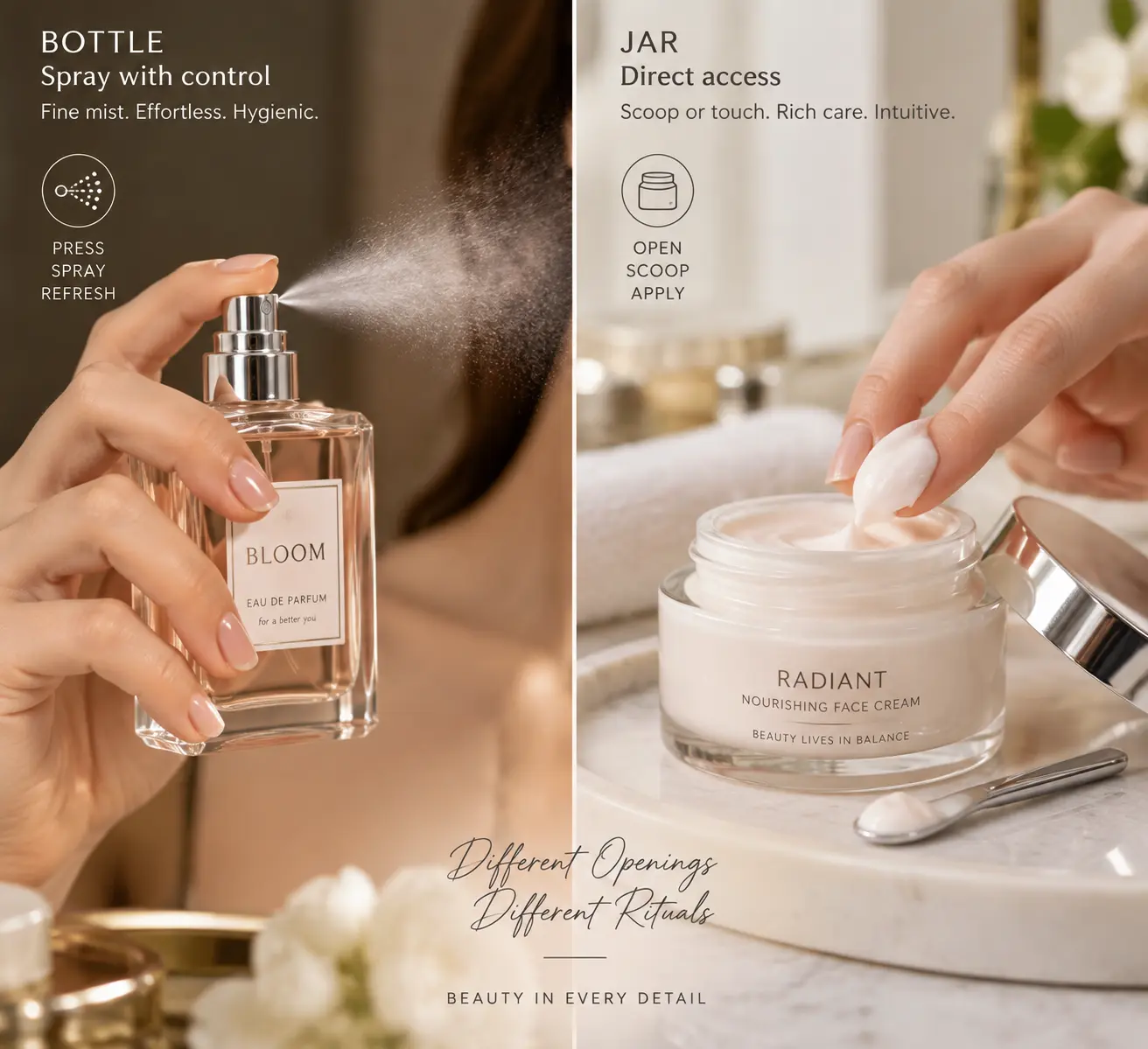
Bottle vs. Jar: The Short Answer
| Fles | Jar | |
| Opening | Narrower than the body | Wide, often close to the body width |
| Neck | Usually visible | Short or almost absent |
| Best for | Liquids that pour, pump, spray or drip | Creams, balms, powders and solids |
| How users access it | Pump, sprayer, dropper, roller or cap | Finger, spatula, scoop or spoon |
| Common examples | Perfume, essential oil, serum and lotion | Face cream, hair mask, balm and candle |
These are practical packaging definitions, not hard rules based on appearance. A short square container can still be a bottle if it has a narrow neck. A tall container may still function as a jar if the user can reach straight into its wide mouth.
If the name on a supplier’s catalogue seems unclear, look at the technical drawing. The ratio between the opening and the body usually settles the question.
What Makes a Container a Bottle?
A bottle is built to move a product through a controlled exit. Sometimes that means pouring. In a perfume bottle, it normally means pushing liquid through a fine-mist pump. Essential oil bottles may use a dropper or rollerball, while a skincare bottle may use a treatment pump.
The narrow opening gives the closure or dispensing system a defined place to attach. Depending on the product, the neck may accept a screw cap, crimp pump, snap-on pump, dropper or plug. The bottle itself is only one part of the package; the closure completes the job.
Take a spray fragrance as an example. Its package includes the glass bottle, pump, actuator, dip tube, gasket, collar and cap. Those parts must fit one another and work with the formula. If the dip tube is too short, perfume remains at the bottom. If the seal is poor, the package may leak. If the pump output is wrong, the spray can feel weak or overly wet.
This is also why “glass perfume bottle” is a category rather than one standard shape. Round, flat, square and sculptural bottles can all use the same narrow-neck principle. MUB’s perfume bottle collection shows how much the silhouette can vary without changing the basic function.
What Makes a Container a Jar?
A jar is made for access. Its wide mouth lets the filling nozzle handle a thick product and allows the customer to remove that product without forcing it through a pump or narrow opening.
Think of a face cream. You can sweep a finger or spatula across the surface and take the amount you want. The same package style works for hair masks, body butter, lip balm, loose powder and candle wax. These products would be awkward—or impossible—to dispense through a conventional fragrance sprayer.
That convenience comes with a trade-off. Removing a jar lid exposes a broad surface of the formula. Fingers can also come into direct contact with the contents. The US Food and Drug Administration lists consumer use, including dipping fingers into a product, as one possible route for microbial contamination in cosmetics. That does not make jars unsafe, but the formula, preservative system and expected use all need to suit the package.
Some brands include an inner disc or spatula. Others choose an airless jar-style dispenser when they want the look of a jar with less direct contact. Once again, the right choice depends on what is inside.
Why Does Liquid Perfume Come in a Bottle?
Most spray perfumes are thin liquids applied in small amounts. A bottle and atomizer handle that job much better than a wide-mouth jar.
You get a usable mist, not an open pool of fragrance
Imagine trying to apply eau de parfum from a jar. You would need to dab it on, pour it into your hand or use a separate applicator. Spills would be easy, and the amount would change every time.
A perfume sprayer turns the liquid into droplets and directs them toward the skin or clothing. The application is cleaner and far easier to repeat. Even the feel of the pump matters: a smooth press and even mist make the finished product feel considered.
The neck supports the sealing system
The narrow neck gives the pump a precise connection point. Perfume bottles commonly use crimp, screw, snap-on or refillable systems. None is automatically best. The choice depends on the bottle neck, pump, formula, filling process and whether the brand wants the package to be refillable.
A product such as this 30ml, 50ml and 100ml crimp perfume bottle is intended to work with a spray assembly. Before ordering at scale, the brand still needs to confirm neck dimensions, pump fit, dip-tube length and sealing performance with its actual fragrance.
MUB’s guide to choosing a perfume sprayer covers the parts worth checking before a bottle and pump go into production.
Glass suits both the formula and the shelf
Glass remains common in fragrance packaging for good reasons. It can be clear, coloured, frosted, coated or printed. It also gives brands control over weight and shape, two details customers notice as soon as they pick up the package.
On the technical side, glass is nonporous and impermeable. The Glass Packaging Institute also notes its very low rate of chemical interaction in its overview of glass packaging. Compatibility testing is still necessary because a finished perfume pack includes more than glass; the formula also contacts parts of the pump and sealing system.
Can Perfume Ever Go in a Jar?
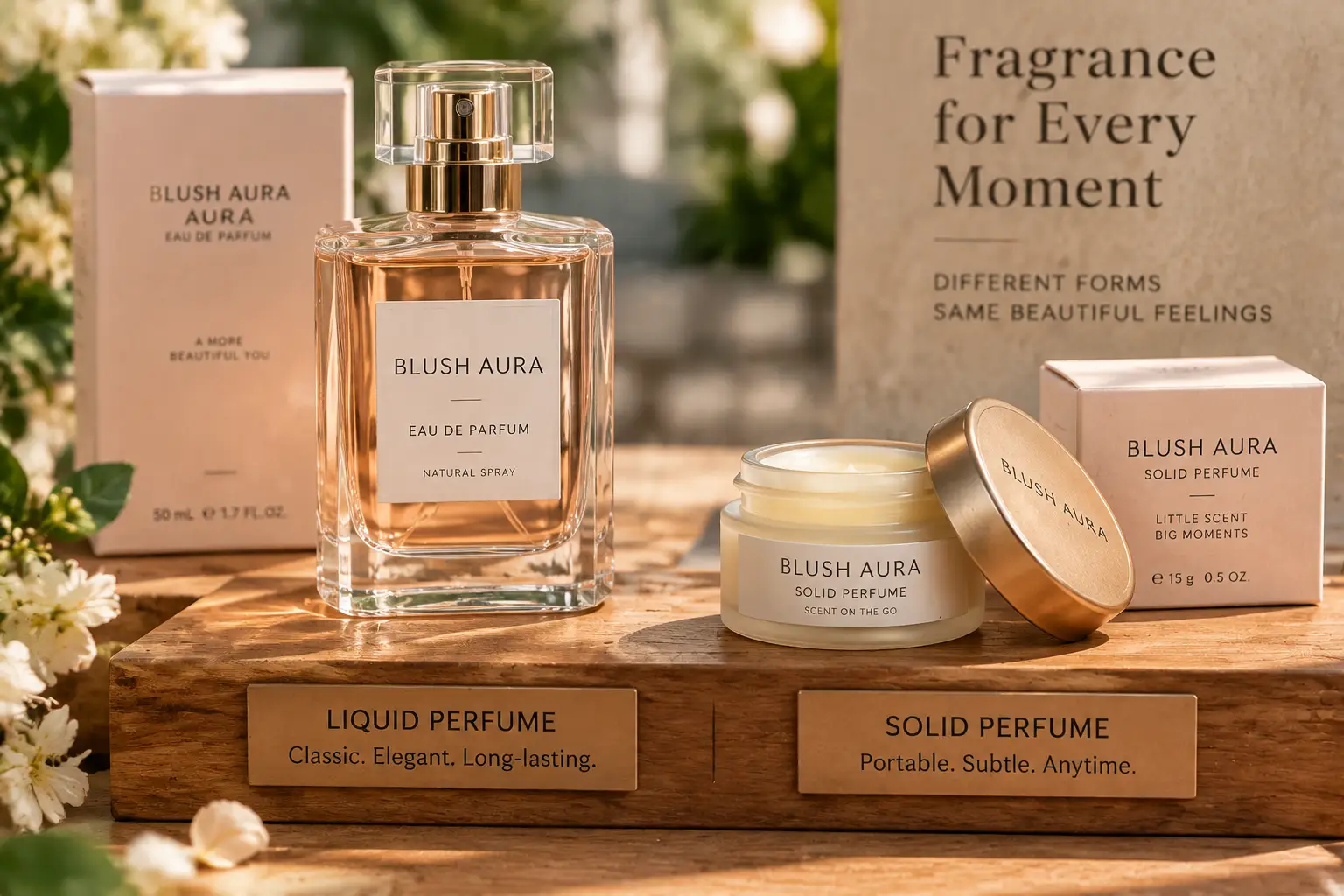
Yes. Solid perfume is the obvious example.
Solid perfumes use waxes, butters or other carriers that give them a balm-like texture. They do not travel up a dip tube or pass through a fine-mist nozzle. A small jar or pot lets the customer rub the surface and apply the scent to the skin.
Liquid eau de toilette or eau de parfum is another matter. A jar gives poor control and leaves a large opening every time the product is used. A traditional dab bottle can work, but it remains a bottle: the narrow neck and stopper limit the flow even though there is no spray pump.
So the useful rule is not that every fragrance must use the same package. Match the opening and dispensing method to the physical form of the product. Liquid spray perfume calls for a bottle. Solid perfume usually calls for a jar, pot or compact.
Choosing the Right Package for a Cosmetic Product
Start with the formula. Packaging appearance matters, but it cannot rescue a container that is frustrating to fill or use.
Thin liquids usually need a spray, dropper, roller or pump. Thick creams and solid balms often need the open access of a jar. Once that choice is clear, confirm the neck drawing and closure dimensions; parts that look compatible in a photograph may not seal in production.
Test the finished package with the actual formula, too. Water can reveal an obvious spray problem, but it cannot prove compatibility with alcohol, fragrance oil or colourants. Fill a sample, use it as a customer would, then run the planned leakage, storage and transport checks.
The sales channel matters as well. A perfume bottle on a beauty counter faces different handling from a sample sent through the post.
Veelgestelde vragen
Is a jar simply a wide-mouth bottle?
The terms sometimes overlap in catalogues, but they describe different user access. A bottle controls the product through a relatively narrow opening. A jar opens wide enough for direct access to most of the contents.
Is a jar better for cosmetics?
It is better for some cosmetics, particularly thick creams, balms and masks. Pumps or narrow-neck bottles usually suit thin formulas and products that benefit from controlled dosing or less direct contact.
Why is perfume stored in a glass bottle?
A glass perfume bottle combines formula protection, decoration options and a rigid structure that can support a spray system. The complete package still needs compatibility and leakage testing.
What is the best container for solid perfume?
A small jar, pot or compact is usually practical because the customer can touch the wax-based formula directly. Portability, closure security and material compatibility should guide the final choice.
A Simple Way to Remember the Difference
If the product should come out through a controlled opening, start with a bottle. If the user needs to reach in, start with a jar.
For most liquid fragrances, that decision leads to a perfume bottle with a properly matched sprayer. For a cream, balm or solid perfume, the wide access of a jar is often more useful. Choose the package around the formula and the way people will actually use it—not around the label printed in a catalogue.