
Picture this. A customer buys your best scent. They love the smell. They love the box. They even love the heavy glass bottle. But two weeks later, they open their bag. It’s a disaster. The perfume has leaked. It stained the lining, and the expensive juice is wasted. They won’t blame the pump maker. They will blame jij.
Leakage is a silent killer for perfume brands. It hurts more than just the package. It breaks trust. It is easy to say the goods are “defective.” But the truth is often more technical. In 90% of cases, leakage doesn’t happen because of one broken part. It happens because the pump and the bottle were not a perfect match.
Want to grow your fragrance line? Stop looking at pumps as just “extras.” Treat them like precision engines. This guide will show you exactly why pumps fail. We will also look at how to pick the right parts. You want your product to stay in the bottle until your customer sprays it.
The Diagnosis: Why Do Pumps Leak?
To fix the problem, you need to know where to look. Most brands think a leak means a crack in the glass. Or maybe a broken nozzle. However, the real cause is usually invisible. It comes down to physics and chemistry.
The Tolerance Gap
This is usually the main reason. In making things, every glass bottle neck has a “tolerance.” Every pump does too. This is a tiny margin of error in size.
Say your glass bottle neck is on the small side of this range. And say your pump’s inner collar is on the large side. You get a gap. We are talking about fractions of a millimeter here. But perfume is a thin liquid. It has high alcohol content. For perfume, that 0.1mm gap is like a highway. Liquid gets pulled up through the threads or the crimp. Then, it slowly leaks out. This often happens with standard glass bottles wholesale if the supplier does not check neck sizes strictly.
Gasket Material Failure
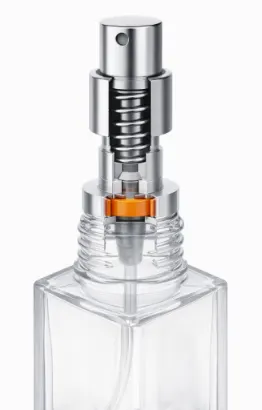
Inside every pump, there is a tiny ring. It is called a gasket. It acts as the last seal between the pump and the glass.
Many cheap pumps use generic PE (Polyethylene) gaskets. These work fine for water. But perfume is strong. Essential oils and alcohol can attack cheap rubber over time. It makes it swell or shrink. Once that gasket changes shape, the seal breaks. You might not see a leak right away. But after three months on a shelf, the bottle starts to “sweat” around the neck.
Wrong Dip Tube Length
It sounds small, but it matters. The length of the plastic tube that sucks up the perfume is key.
If the dip tube is cut too long, it hits the bottom of the bottle. Then it bends too much. This creates an upward push. It pushes the whole pump mechanism slightly away from the bottle neck. Over time, this constant push weakens the crimp or the screw thread. It makes a path for liquid to escape.
The Solution: How to Choose the Right Pump
You know the risks. So, how do you stop them? Picking the right pump is not just about choosing a color like gold or silver. You need to look at the mechanics. It doesn’t matter if you want a refillable screw-neck bottle or a standard crimp style. The rules for quality are the same.
Material Compatibility
First, look at what the pump is made of. Good pumps use parts that resist damage. Look for specific grades of polypropylene or metal-covered actuators.
You must make sure the gasket material inside the pump works with your specific scent. Do you have high amounts of citrus oils or vanilla? You might need a special silicone or NBR gasket. These won’t break down. Ask your supplier for a “compatibility test” report. Don’t just guess. Chemistry doesn’t lie.
The “Pull Force” Test
Is that pump on tight? In the industry, we measure this with a “pull force” test.
Take a crimp pump. The metal skirt should wrap under the glass bead very tightly. It should take a lot of force to rip it off. If the aluminum is too soft, or the machine is set too loose, the pump will spin. If it spins, it leaks. Simple as that. When you buy perfume spray pumps, ask the factory about their standards. They should give you a specific number for how much force their crimp can handle.
Actuator Quality and Spray Pattern
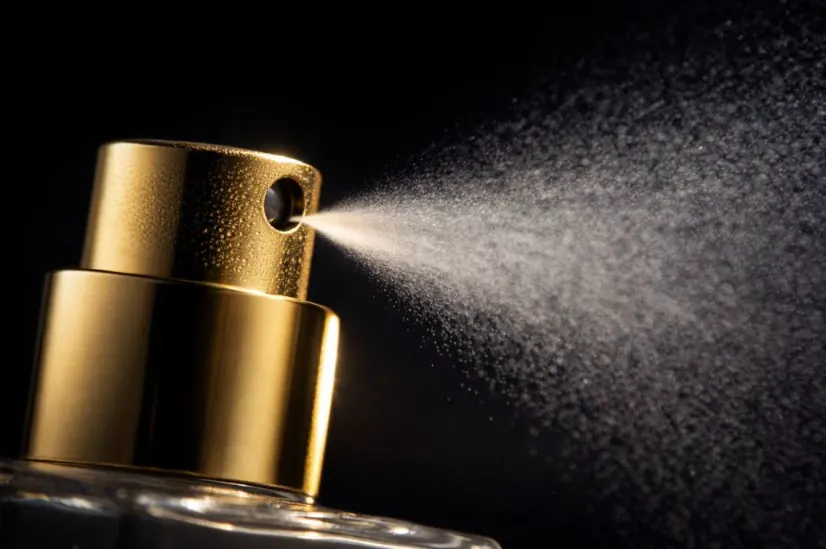
This might not stop leaks directly. But it is a huge sign of quality. A cheap pump “spits” big drops. A premium pump gives a “fine mist.”
This mist comes from the nozzle design. The best pumps use a swirl chamber inside. It breaks the liquid into tiny bits before it leaves the hole. If a maker cares about the spray pattern, they usually care about the seal too. It shows they care about how the engine works.
Crimp vs. Screw Necks
You have a choice. Crimp or Screw?
- Crimp Pumps: These are standard for retail. A machine forces the metal skirt onto the bottle. It is permanent. It usually gives the safest seal. It cannot shake loose during shipping.
- Screw Pumps: These are getting popular for eco-friendly lines. The risk? A customer might unscrew it. Or vibration might loosen it. But modern luxury screw pumps have a “friction” system. It keeps the pump tight unless you really try to open it.
MUBTF’s Quality Control Protocol
Bij MUB, guessing is never part of the process. A single leak can ruin an entire shipment. Therefore, a strict “Vacuum Test” is standard on the production lines.
It goes beyond just looking at the bottle. Random samples go into a vacuum chamber. The air gets sucked out to create negative pressure. If even a tiny path exists for air to escape, the liquid inside forces its way out. It becomes visible immediately. This mimics the pressure changes of an airplane flight. If a bottle passes this vacuum test, it will survive a trip to New York or London. Not a drop will be lost.
Conclusie
The package is the body of the product. The pump is the heart. If the heart fails, the product dies. Attention must be paid to small details like tolerance gaps, gasket materials, and dip tube lengths. This protects a brand from the shame of a leaky bottle.
Do not let a cheap part ruin a big sale. Take the time to match the pump to the bottle the right way. Unsure where to start? Finding a partner who knows the engineering, not just the looks, is critical.
Partner with Precision: MUB Perfume Packaging
MUB (Yiwu Yujin Import & Export Co., Ltd.) started in 2011. Since then, MUB Perfume Packaging has spent over 15 years mastering fragrance packaging. This is not just about being a supplier; it is about acting as a technical partner.
With a 5,000 square meter factory, the focus remains strictly on quality. This dedication has earned trust from global names, including long-term cooperation with prestigious brands like CREED. Operations are SGS certified, ensuring every bottle and pump meets world standards.
The specialty is “One-Stop Solutions”. Everything is managed, from glass mold design and polishing to perfectly matching pumps and caps. Whether the need is for Zamac caps that click loudly or leak-proof aluminum perfume atomizers, the expertise is available. Plus, a low MOQ of just 500 pieces is offered for OEM/ODM orders. This helps niche brands access world-class packaging without spending a fortune.
Quality is the culture here. Let MUB handle the technical challenges, allowing you to focus on the fragrance.
Veelgestelde vragen
Q1: Why does my perfume leak when I travel by plane?
A: It’s the pressure. Cabin pressure drops, while the pressure inside your bottle stays high. This pushes liquid out through any small gap. A pump that passes a vacuum test usually handles this fine.
Q2: How do I know if my dip tube is the right length?
A: The tube should curve a little bit into the corner of the bottle. It looks like a hockey stick. If it bends too much like a “U,” it’s wrong. If it stands straight up without touching the bottom, it’s also wrong.
Q3: Can I use a generic pump on any bottle?
A: Not really. The neck size might say “15mm,” but the height and glass thickness vary. You always need to test that specific pump with your specific bottle.
Q4: What is the difference between a crimp and a crimpless pump?
A: A crimp pump needs a machine to seal it forever. A crimpless (or screw) pump can be put on by hand. It can be taken off too. This makes it great for refillable products.
Q5: Does MUB offer custom logo printing on pumps?
A: Yes, we do. We can put your logo on the actuator or the metal collar. We use embossing or laser engraving. It gives your pump an extra special touch.